

Helping With the Vehicle Does Not Settle the Signature Question
The keys and paperwork may be ready to hand over. Confirm whose authorization the receiving office needs before arranging the notary appointment.
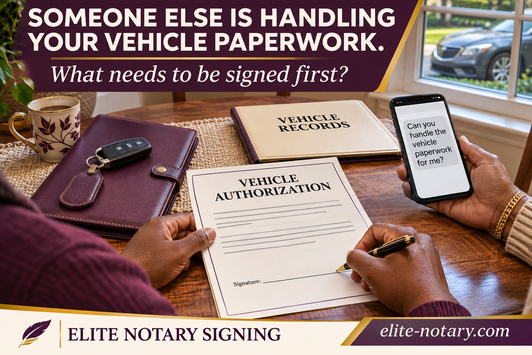
You have the keys, the folder, and someone willing to handle the vehicle paperwork. Perhaps work keeps you away from the tag office, or a relative is helping with the transaction. Then the office asks for the owner’s authorization.
Confirm which document and whose signature the receiving office requires before arranging notarization. Elite Notary Signing provides mobile notarization for eligible completed vehicle documents in Duluth, Gwinnett County, and Metro Atlanta, including vehicle powers of attorney when appropriate.
The practical question is not simply who will carry the paperwork. It is who must authorize the requested action, and how that authorization needs to be signed.
The Person Helping May Not Be the Person Who Must Sign
Imagine an adult daughter offering to handle a transaction for her father. She can collect the instructions and coordinate the appointment. That does not make her the signer of a document requesting her father’s authorization.
If the form calls for the owner’s notarized signature, plan for that owner to participate in the notarial appointment. Bringing the owner’s identification while the owner is elsewhere does not substitute for the owner’s participation.
When someone else will handle your vehicle transaction, ask the receiving office which authorization it requires and whose signature needs notarization. Elite Notary Signing can support the notarial step for an eligible completed document after those details are confirmed.
Where Georgia’s Vehicle Power of Attorney Fits
The Georgia Department of Revenue publishes Form T-8, Limited Power of Attorney for Motor Vehicle Transactions. Its purpose is connected to authorizing another person for specified vehicle matters. That does not mean it fits every transaction.
DOR’s power-of-attorney usage guidance explains distinctions between general or limited powers and secure powers of attorney. Ask the tag office, dealership, lender, or other receiving party which requirements apply to your transaction.
ENS does not choose between those forms or decide whether a particular authorization is legally sufficient. Obtain the required document and instructions before requesting the signing service.
Ask Two Separate Questions
“What must the owner sign to authorize this?”
“What will the person handling the transaction need to submit afterward?”
The first question identifies the signing appointment. The second identifies the later handoff. Keeping them separate makes it easier to schedule the right person and avoid treating notarization as the entire vehicle transaction.
Ask whether the office requires an original authorization, whether there are multiple owners or signatures to address, and what accompanying records it expects. These are questions for the recipient, not a universal list of requirements for every vehicle.
Plan the Owner’s Signing Step
Ask the receiving office for the exact form and instructions for this transaction.
Use the confirmed form instructions. Tell ENS the signer count and who is available for the appointment.
Have required vehicle and transaction details completed by the appropriate person. Direct questions about legal wording or authority to a qualified source.
Discuss identification, location, timing, and how the completed authorization will reach the person or office handling the next step.
The keys identify the vehicle.
The authorization identifies who may act.
How ENS Helps With Vehicle Documents
Once the document and signing instructions are identified, ENS can review the requested appointment, discuss identification and signer participation, and confirm availability and pricing. Mobile service may help an owner complete the notarial step at an agreed location.
ENS’s role is the requested notarial act. The receiving office handles its transaction review. A notarized authorization does not, by itself, prove that a transfer, title application, or other submission has been completed.
Not every vehicle record requires notarization. Do not add a notary stamp to paperwork simply because it concerns a car. Follow the form and recipient’s instructions.
Keep the Completed Authorization With the Right Instructions
After the appointment, follow the receiving office’s direction for originals and supporting records. Make sure the person taking the next step knows which office is receiving the packet and what remains to be done.
If there is an ownership dispute, a deceased owner, a business ownership question, or uncertainty about an existing power of attorney, obtain guidance from the appropriate agency or qualified counsel. A notary appointment cannot resolve those questions.
Begin your ENS inquiry with the document name, requested signer, location, and preferred timing. You do not need to email your complete title or identification records just to ask about an appointment.
Elite Notary Signing
Need a vehicle authorization document notarized?
Share the completed document’s name, whose signature is requested, appointment location, timing, and receiving-office instructions.
Add comment
Comments