

Everyone Can Help. Keep the Instructions Together.
When several relatives are coordinating the same paperwork, separate conversations can create conflicting directions. A clear scheduling contact helps keep the appointment connected.
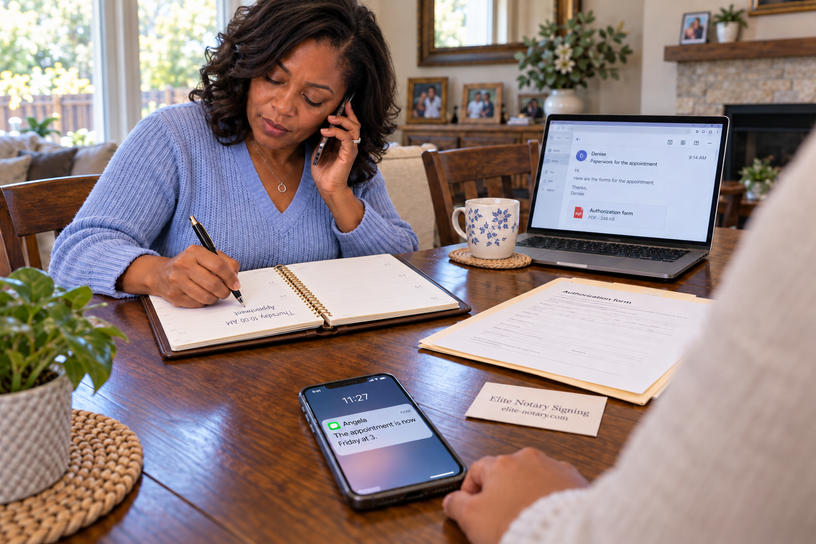
One relative sends the paperwork. Another calls to arrange the appointment. A third says the time has changed, but the person who booked it has not heard that yet. Everyone is trying to help. The instructions are moving in different directions.
Families arranging a mobile notary appointment can run into this kind of confusion when several people communicate separately. Elite Notary Signing can discuss the appointment details with one designated scheduling contact while communicating directly with the signer about the requested notarial act. ENS serves Duluth, Gwinnett County, and Metro Atlanta with notarial services for eligible completed documents.
The goal is to keep the help and bring the information together. A clear contact for logistics does not take away anyone’s voice or give that person legal authority.
What Helps When Too Many People Are Giving Instructions?
Choose one scheduling contact to gather confirmed instructions and communicate appointment changes to the notary. Keep the signer involved, and return questions about document wording or legal authority to the document provider or qualified counsel.
That contact handles communication, not everyone else’s decisions. Other relatives can still help with transportation, locating paperwork, or arranging access. What changes is where appointment updates are collected and confirmed.
When Different Instructions Reach the Signing Table
Several relatives may be helping under pressure, each working from the information they received. The problem becomes visible when those details do not match.
- An earlier document arrives: the signer has one copy while another relative has received a revision. The document provider needs to confirm which version should be used before the signing proceeds.
- A witness was discussed but never arranged: everyone expects someone else to bring the witness. If the confirmed instructions require one, that missing arrangement can affect whether the planned signing can be completed.
- The appointment changed only within the family: relatives agree on a new time or location, but ENS has not confirmed availability. The original booking and the family’s expectations no longer match.
These are practical coordination gaps, not a measure of how much the family cares. Comparing the instructions before the appointment gives everyone a chance to address what is still unresolved.
Keep the document provider’s written instructions with the signing request. If they conflict with another message, ask the provider to clarify them rather than asking the notary to choose the appropriate document or legal requirement.
Give Appointment Updates One Clear Contact
Choose a person who agrees to gather the logistical details and can reach the signer. Make sure ENS knows who that person is and how to contact them.
- Document: which complete version the provider has directed the signer to use.
- Appointment: the agreed date, time, location, and signer count.
- Witnesses: the confirmed requirement and whether arrangements have actually been made.
- Access: parking, facility entry, room details, or other meeting instructions.
- Changes: what has changed and whether ENS has confirmed the updated arrangement.
Ask relatives to pass proposed changes to the scheduling contact. That person can check them with the signer and ENS before treating them as confirmed. A family message saying “we moved it” does not establish that the notary is available at the new time.
Keep the Signer’s Voice in the Appointment
A scheduling contact can explain where to meet and help locate materials. They should not answer every question for the signer or treat the signer’s hesitation as a scheduling problem.
Give the signer space to speak directly with ENS, ask questions, and express whether they wish to proceed. If a question concerns what the document means, resolve it with the document provider or qualified counsel.
GSCCCA’s Georgia notary guidance addresses identity, presence when witnessing a signature, and circumstances in which coercion or demeanor creates compelling doubts about understanding. Family coordination does not replace the applicable notarial requirements.
Resolve the Difference Before It Becomes an Appointment Problem
If two document versions are circulating, ask the provider which one should be used. If witness arrangements are uncertain, confirm who is responsible and whether the person meets the document’s requirements. If the family wants a different appointment time, contact ENS to discuss availability before treating it as reserved.
The scheduling contact can gather those answers in one place and share the confirmed update. That gives ENS a consistent set of logistical details while leaving legal questions with the appropriate professional.
A useful message: “We have received two different instructions. We are checking with the document provider and will send the confirmed version and appointment details before proceeding.”
Record only the unresolved question, the person confirming it, and the response. Keep passwords, identification numbers, account details, and private medical information out of the coordination note.
How Elite Notary Signing Helps Keep the Appointment Clear
ENS’s role is to bring a clear process to the signing appointment. We discuss the completed document type, requested notarial service, signer count, identification, timing, location, confirmed witness needs, and access arrangements with the scheduling contact. During the appointment, we communicate directly with the signer and follow the applicable notarial requirements.
Mobile appointments may be available at homes, workplaces, hospitals, and care facilities within the service area, subject to availability and access. Witness coordination can be discussed after the document’s requirements are confirmed.
If the details conflict, ENS can identify the appointment questions that still need confirmation. The family can then obtain the provider’s clarification, confirm any revised arrangements with ENS, and give the signer room to participate without competing directions. A professional signing process depends on confirmed requirements, not on rushing past an unresolved detail.
Bring the appointment details together.
Have your scheduling contact reach ENS with the completed document type, signer count, location, preferred timing, and confirmed instructions. We can discuss the appropriate appointment arrangements.
Related Resources
Founder, Elite Notary Signing, Duluth, Georgia
Add comment
Comments